Defining Interactive Experience Design and Why It Matters Today
Interactive experience design uses multisensory stimulation, technology integration, and spatial storytelling to create an immersive experience for participants. Howdy Creative believes this is the core competitive edge of contemporary exhibition and spatial design.
Unlike the one-way viewing of a traditional exhibition, interactive experience design invites participants to become co-creators of the narrative. By integrating sight, sound, touch, and even smell, it builds an experience that’s hard to forget.
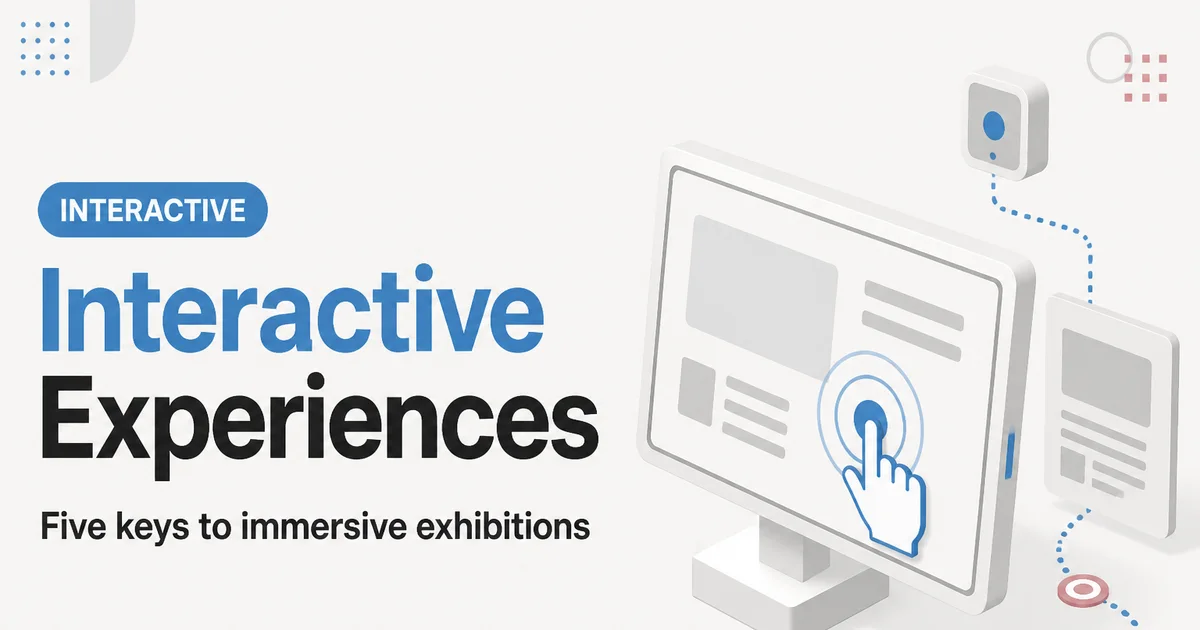
Five Key Elements of Interactive Experience Design
Great interactive experience design must integrate five core elements. None of them is optional.
Element 1: Sensory Design and Atmosphere
Sensory design is the foundation of immersion. Sight, sound, lighting, materials, and scent: every detail is telling a story.
Good sensory design guides participants’ attention and emotion. Dim lighting paired with calm music can create a sense of solemnity; bright colors and up-tempo music can spark energy. This isn’t decoration — it’s part of the narrative.
Element 2: Narrative Structure and Layered Content
Every exhibition should have a clear narrative arc: opening, development, climax, and conclusion. A good narrative guides participants’ thinking and emotions.
At the same time, content should be layered. The surface layer is visual enjoyment, the middle layer is knowledge transfer, and the deep layer is values and emotional resonance. Participants from different backgrounds can each find their own point of entry.
Element 3: Technology Integration and Innovative Application
Technology is a tool for amplifying the experience, not the goal itself. Projection, AR, VR, sensors, and interactive installations should all serve the narrative.
The key is moderate use. Piling on too much technology scatters attention and actually weakens the experience. Good technology integration should be invisible — participants should feel the experience itself, not the technology behind it.
Element 4: Spatial Flow and Participation Mechanism Design
How participants enter, move, and interact should all be carefully designed. The flow should guide participants to advance the narrative naturally.
The interaction mechanism determines the depth of participation. Manual button interaction, body sensing, shared decision-making, creative contribution — different mechanisms create different levels of engagement and memory strength.
Element 5: Cultural Context and Local Connection
The most powerful experiences are usually rooted in local culture and the participants’ own lived context. Interactive experience design should connect with participants’ identity, memories, and values.
By weaving in local elements, community stories, and cultural symbols, an experience can gain deeper resonance and meaning. This is also why local exhibitions often draw local audiences more strongly than imported ones.
Common Interactive Technologies and Applications
Modern exhibitions have many technologies available. Choosing the right one is a key design decision.
Projection Mapping and Visual Projection
Projection can turn a static space into a dynamic narrative scene. Layered projection can create depth and a sense of magic.
Common in museums, cultural exhibitions, and brand events. Cost is relatively low, maintenance is simple, and it suits small and midsize venues.
Immersive VR and AR Experiences
VR takes participants into a fully virtual world, suited to sci-fi, historical recreation, and highly sensory experiences. AR overlays digital content onto real space, suited to education and interactive games.
Technology costs are higher, but immersion is strong and memorable. Suited to flagship exhibitions or specific themed zones.
Sensor Interaction and Installation Art
Using motion sensing, touch sensing, weight sensing, and the like creates interaction between participants and the installation. A participant’s movement directly affects the visual or sound output.
This kind of interaction is highly engaging and loved by adults and children alike. Cost depends on complexity, ranging from a few thousand NT dollars for simple sensors to hundreds of thousands for complex installations.
Multimedia Storytelling and Video Displays
Video, slideshows, and animation remain the most effective tools for delivering a narrative. Combined with a soundtrack and environmental design, they can create a powerful storytelling experience.
Production cost depends on content complexity, but it’s generally easier to control the budget than with other technologies.
Soundscape and Immersive Music Design
Sound design is often overlooked, but it’s the unsung hero of the experience. Background music, ambient sound effects, and audio guides all directly shape emotion and attention.
Investing in professional soundscape design is inexpensive but highly effective. Many exhibitions see a clear boost in participant satisfaction after upgrading their audio.
Process and Budget Planning for Interactive Experience Design
From concept to execution, an interactive exhibition requires a systematic design process.
Phase 1: Concept and Narrative Development
Define the exhibition’s core narrative, target participants, and key messages. This phase doesn’t involve technology at all — it’s purely about story and strategy.
Budget: NT$30,000-50,000 (depending on the scale and depth of consulting).
Phase 2: Spatial and Interaction Design
Design the exhibition’s spatial flow, interaction mechanisms, visual style, and technology approach. Deliverables include concept diagrams, 3D models, and interaction flowcharts.
Budget: NT$50,000-150,000.
Phase 3: Content and Technology Production
Produce the video, animation, interactive programs, and sensor systems. This is the phase with the highest budget.
Budget: from NT$200,000 to over NT$5,000,000, depending on technical complexity.
Phase 4: Construction and Installation
Spatial renovation, installation setup, lighting calibration, and audio system testing.
Budget: 20-30% of the total budget.
Phase 5: Opening and Evaluation
The opening event, operational training, participant feedback collection, and results evaluation.
Budget: NT$50,000-100,000.
Overall Budget Benchmarks
Small exhibition (single space, simple interaction): NT$300,000-500,000. Medium exhibition (multiple spaces, moderate technology): NT$1,000,000-3,000,000. Large flagship exhibition (complex narrative, high-end technology): NT$5,000,000 or more.
Recommended budget allocation: 5% narrative development, 15% design, 50% content production, 20% construction, 10% operations and evaluation.
Successful Examples of Interactive Experience Design in Taiwan
Taiwan has many excellent interactive exhibitions that showcase strong local design capability.
A National Art Museum’s Digital Art Exhibition
Blending traditional art with new media technology to create a dialogue across eras. Participants can interactively control the digital artworks, changing how the narrative unfolds.
Case takeaway: combining high-end technology with cultural depth can attract participation across a broad age range.
A Taiwan Museum’s Permanent Exhibition Renovation
Converting a static artifact display into an immersive narrative experience. A timeline, multimedia imagery, and sensor-driven interaction turn participants into participants in history rather than mere onlookers.
Case takeaway: even a traditional exhibition can be brought back to life through interactive experience design.
An Immersive Space at a Flagship Brand Store
A well-known brand built a full-sensory retail experience: visual projection, soundscape design, tactile interaction, and scent guidance. Participants get a story experience while shopping.
Case takeaway: interactive experience design isn’t limited to exhibitions — it can also be applied in commercial spaces to raise brand value.
New Trends in Sustainable Exhibition Design
Environmental sustainability and social responsibility have become essential considerations in contemporary exhibition design.
Recyclable and Eco-Friendly Materials
Waste disposal after an exhibition ends is a problem exhibition design must confront. More and more exhibitions are adopting recyclable, reusable materials.
Modular design also lets exhibition installations be repurposed elsewhere, extending their usable life.
Energy Efficiency and Low-Carbon Operations
LED lighting, energy management systems, and the integration of natural light all reduce an exhibition’s energy consumption.
Many large exhibitions now publish their carbon footprint data and commit to net-zero emissions targets.
Community Participation and Co-Creative Design
Exhibitions are no longer just something designers make for the public to view; they’re co-created with communities. Local residents take part in the design, production, and operation, ensuring cultural representation and community benefit.
This co-creative model also extends an exhibition’s lifecycle, giving participants a stronger sense of ownership and a greater willingness to return.
Evaluating and Optimizing Interactive Experience Design
Evaluation and optimization matter just as much after an exhibition opens. Data can help improve the experience.
Tracking Participant Behavior and Data Analysis
Heat-map analysis, dwell-time statistics, and interaction-frequency counts reveal how participants actually behave: which areas draw people in, and which interaction mechanisms are most popular.
This data guides subsequent adjustments and optimization.
Surveys and Interview Feedback
Ask participants directly about their experience: satisfaction with the sensory experience, comprehension of the narrative, usability of the interaction mechanisms, and overall impression scores.
Qualitative feedback can surface problems and insights that quantitative data alone cannot show.
Long-Term Impact Evaluation
After an exhibition ends, track participants’ knowledge retention, attitude change, willingness to recommend, and how much it’s being discussed in the community.
A good exhibition should keep resonating in participants’ minds long after it closes, with an impact that outlasts the show itself.
A Growth Path From Small-Scale Experiments to Large Exhibitions
Interactive experience design doesn’t have to start with a huge budget. Many successful cases began as small-scale experiments.
Experimenting With a Small Interactive Installation
Within a limited budget and space, design a small interactive installation. Observe participant reactions, collect feedback, and iterate quickly.
This process validates the concept, builds team experience, and accumulates a track record of success.
Pop-Up Exhibitions and Temporary Spaces
Hold a short-term exhibition in an existing commercial space (a department store, bookstore, or gallery). Low cost, short timeline, and easy to test.
A successful pop-up exhibition can draw media and social media attention, which in turn attracts longer-term partnership opportunities.
Partnering With Existing Institutions
Partner with a museum, gallery, or cultural institution to renovate an existing space, sharing development costs and risks.
A partnership can also leverage the institution’s foot traffic and credibility to boost visibility.
Howdy Creative’s Interactive Experience Design Services
Howdy Creative has 8 years of experience in interactive exhibition design. Our services span strategy, design, production, and evaluation.
Integrated Design From Narrative to Technology
We don’t just handle visuals or technology — we start from the narrative and integrate every design dimension, ensuring a perfect harmony of story, space, technology, and interaction.
Our design process includes: cultural diagnosis → narrative development → concept design → detailed design → production oversight → opening evaluation.
From Budget-Friendly Small Installations to Complex Large Exhibitions
Whatever the scale, we can provide professional design. Small interactive installations start at NT$300,000, while large immersive exhibitions can run into the tens of millions.
Browse our interactive experience design case studies。
Start Your Interactive Experience Design Journey
Whether you’re an art museum, a museum, a brand, or a local cultural institution, interactive experience design is worth the investment.
The first step is self-diagnosis: What story do you want the exhibition to tell? Who is your target participant? What are your budget and time constraints?
Howdy Creative offers a free initial consultation to help you clarify direction and feasibility.Learn about our team’s backgroundand design philosophy.
Want to dive deeper into the theory and practice of interactive design? We recommend IDEO’s design thinking resources (ideo.com), Design Council’s user experience guide (designcouncil.org.uk), and Nielsen’s usability research reports.
Frequently Asked Questions (FAQ)
How is interactive experience design different from a traditional exhibition?
A traditional exhibition is one-way viewing. Interactive experience design instead invites participants to become co-creators of the narrative, integrating sight, sound, touch, and other senses so participants take part in person rather than just watching.
Roughly how much budget do you need for an interactive exhibition?
It depends on scale: a small exhibition typically runs NT$300,000-500,000, a medium one NT$1,000,000-3,000,000, and a large flagship exhibition can exceed NT$5,000,000. The actual cost depends on narrative complexity and technical specifications.
What technologies are commonly used in interactive exhibitions?
Common choices include projection mapping, immersive VR and AR, motion-sensing installations, multimedia storytelling, and soundscape design. The actual choice should depend on the exhibition’s narrative needs and budget, not on stacking up technology for its own sake.
Can you do interactive experience design without a large budget?
Yes. Many successful cases started with a small interactive installation or a pop-up exhibition, testing the concept and collecting participant feedback within a limited space and budget, then gradually scaling up to a larger exhibition.
How do you know if an interactive exhibition worked well after it ends?
You can track participant behavior, such as dwell time and interaction frequency, combine that with survey and interview feedback, and continue tracking long-term effects like knowledge retention and willingness to recommend after the exhibition closes.

The Future of Interactive Experience Design
As technology advances and society changes, the forms interactive experience design takes keep evolving.
Artificial intelligence and machine learning can create personalized experiences, recording participants’ preferences and dynamically adjusting exhibition content. Blended physical-and-digital exhibitions are becoming a trend, with online and offline narratives complementing each other. Community co-creation and participatory design will become more common, turning exhibitions from one-way delivery into multi-directional dialogue.
Howdy Creative continues to explore these new possibilities, hoping that interactive experience design can create cultural events that are more meaningful and carry a greater social impact.
If you have a plan for an exhibition or spatial design project, let us be your design partner.Browse our brand and experience design services, or contact us directly to discuss your project.