- Taiwan’s standard business card is 90×54mm, which differs from Japan (91×55mm), Europe (85×55mm) and the US (88.9×50.8mm).
- A business card is the smallest complete implementation of an identity system, not a standalone design item.
- Design fees are one time; print costs scale with quantity and finishing. Quote them separately.
- Taiwan’s print supply chain is dense and fast, which makes short lead times and small runs practical.
If you are reading this, you have probably already met us, received a card, or been introduced. This page exists so you can check whether we actually know what we are doing before you send an enquiry.
It covers how we approach business card and print identity work, what the specifications are in Taiwan, and what working with a Taiwan based studio looks like in practice.
What is a business card, in design terms?
A business card is a brand identity system compressed onto a 90×54mm surface. It has to solve three things at once: information hierarchy, tactile quality, and print feasibility. Anything that fails one of those three fails as a card.
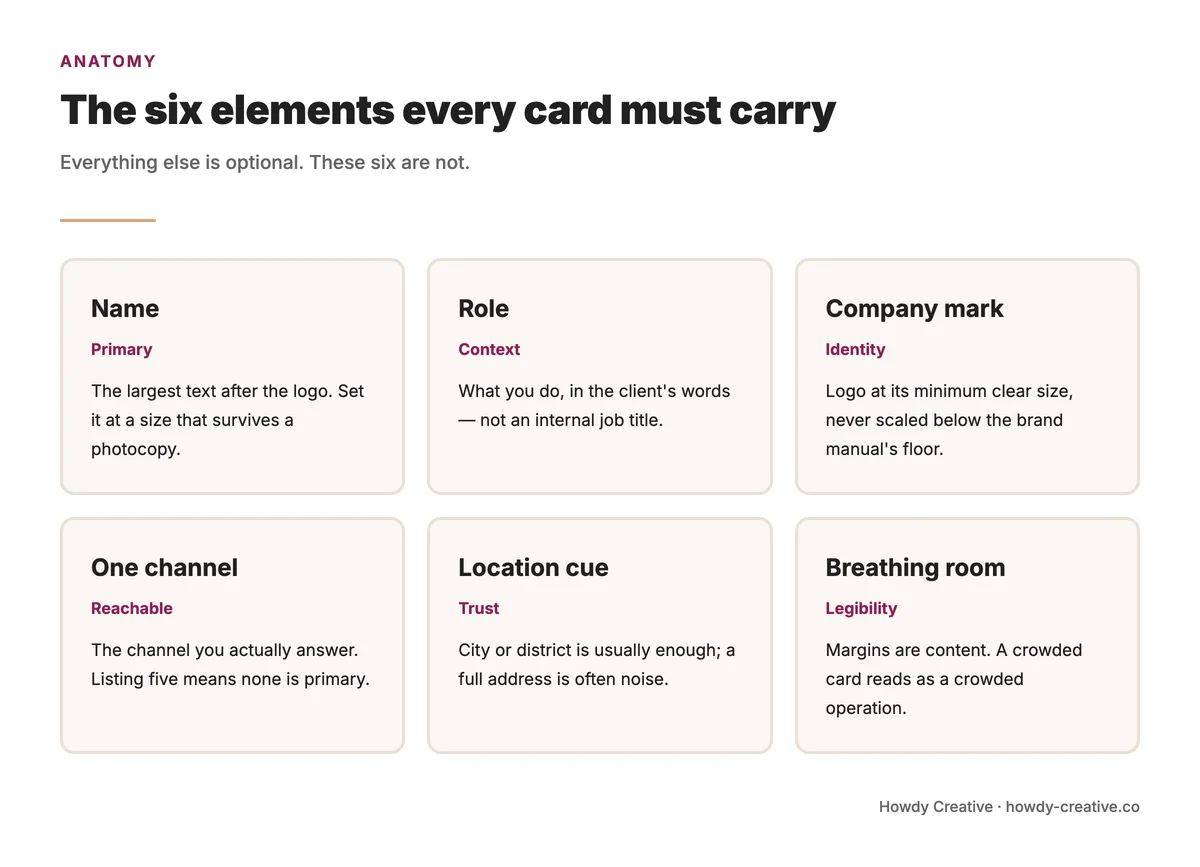
This is why we do not take on card design as an isolated job. If an identity system already exists, the card is an application of existing rules. If it does not, the card becomes the de facto starting point for the identity, and it deserves to be treated that way.
What size is a business card in Taiwan?
The standard business card size in Taiwan is 90×54mm. With bleed, artwork is prepared at 92×56mm, adding 1mm on each edge. Content should stay at least 3mm inside the trim line.
That figure is not universal. Japanese cards are 91×55mm, most of Europe uses 85×55mm, and North America uses 3.5×2 inches (88.9×50.8mm). If your cards will be exchanged across those markets, this matters more than it sounds: Japanese card cases are built to 91×55mm, so a Taiwanese card sits loose inside one.
Full specifications, bleed settings and safe areas for each region are in our international business card size guide.
What can Taiwan’s print industry actually do?
Taiwan has a dense, geographically concentrated print supply chain. Paper merchants, offset printers, and finishing houses often operate within the same district, which makes short lead times and small runs commercially viable.
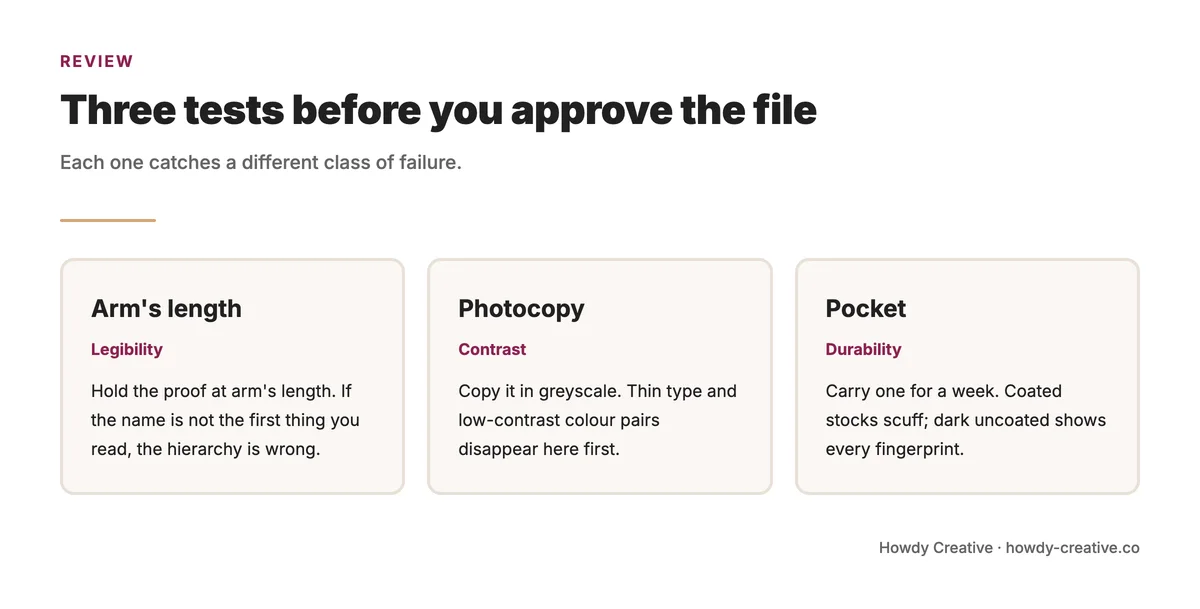
In practice this means three things for an overseas client. Small runs are possible without punitive minimums. Specialist finishing such as letterpress, foil and embossing is widely available. And proofing cycles are short, often measured in days rather than weeks.
The trade off is that specifications must be communicated precisely, because the process moves quickly. Details on stocks, finishes and realistic timelines are covered in print production in Taiwan.
How do you work with clients in other time zones?
Taiwan is UTC+8. That gives a working overlap of roughly two to four hours with Central Europe in the late afternoon Taipei time, and almost none with the US west coast during normal hours.
Rather than pretend that overlap does not matter, we structure projects around asynchronous review. Each stage ends with a written deliverable and a specific decision request, so a review cycle costs one working day rather than one scheduling attempt. The full process is described in working with an overseas design studio.
How much does identity design cost?
Identity work is scoped by the number of applications and the depth of the strategy stage, not by the number of design hours. A card alone is rarely quoted separately, because the cost of getting it right depends almost entirely on whether the underlying identity exists.
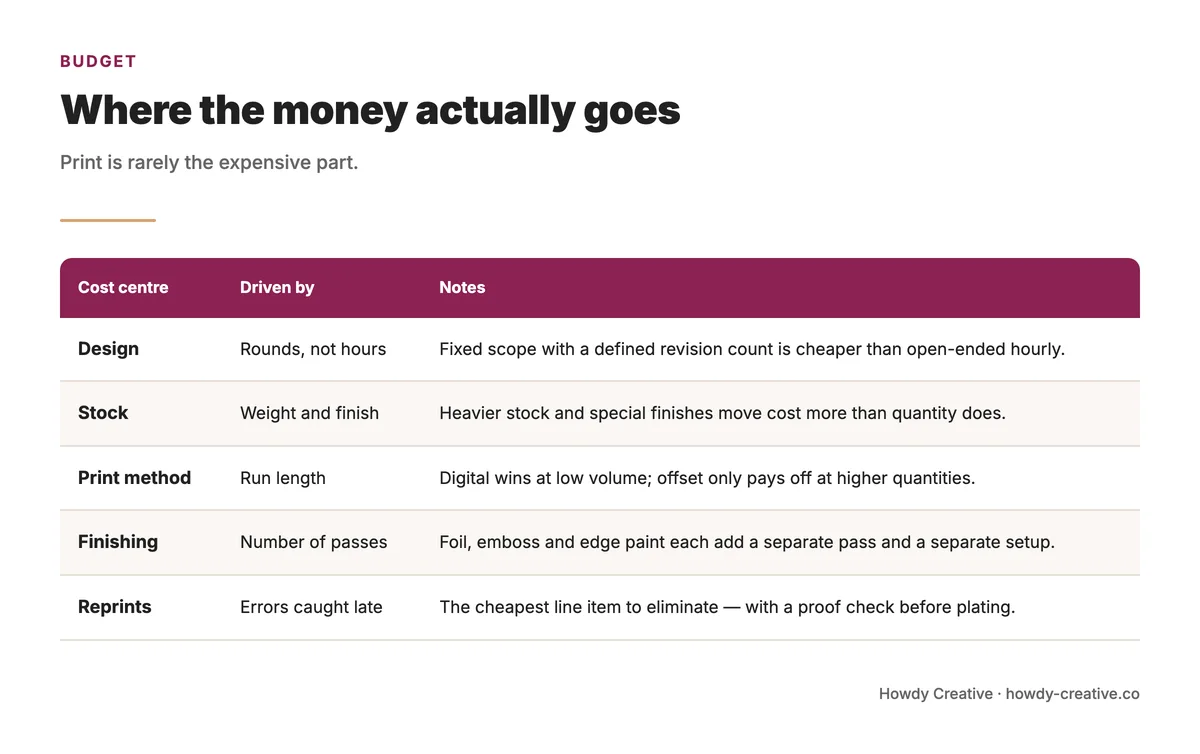
Print costs are separate and behave differently. They are driven by quantity, paper and finishing, with setup costs that do not scale down. This is why a run of 200 cards with foil can cost more per card than a run of 2,000. How we structure scope and quotes is explained in how identity projects are scoped and priced.
What do you receive at the end of a project?
You receive print ready files, editable source files, and a written specification of colours, typefaces and usage rules. Ownership and licensing are stated in the agreement before work begins, not negotiated afterwards.
The one area that requires attention in cross border work is typeface licensing, since the licence held by the studio does not automatically transfer to the client. We flag this at the specification stage. Details are in design file handoff.
Do you work in both Chinese and English?
Yes, and bilingual identity work is a distinct discipline rather than a translation task. Chinese characters and Latin letters have different optical weights, x heights and spacing behaviour, so a layout that works in one script rarely works unmodified in the other.
On a card this becomes concrete very quickly. A Chinese name occupies far less horizontal space than its romanised equivalent, which changes the entire balance of the layout. Our approach to this is set out in designing bilingual identity systems.
Who are we?
Howdy Creative is a brand design and cultural planning studio based in Taichung, Taiwan. Our work spans brand strategy, visual identity, exhibition planning and market curation. Howdy Creative was certified as a B Corporation in 2020, with a certification period running from 2020 to 2023.
We work primarily in Traditional Chinese for the Taiwanese market, and in English for international projects. Background on our approach to brand work is available in our brand design guide, and our sustainability practice is described in the ESG brand guide.
Frequently asked questions
Do you take on card design as a standalone project?
Rarely. A card without an identity system behind it tends to get redesigned within a year, which costs more overall. If you have existing brand guidelines we can work directly from them. If you do not, we would usually propose defining a minimum viable identity first.
Can you handle printing for an overseas client?
Yes. We can manage production in Taiwan and ship finished cards, or supply print ready files for your local printer. Which is better depends on quantity, finishing requirements and how quickly you need them. Shipping cost is rarely the deciding factor for something as light as cards.
What file formats do you deliver?
Print ready PDF with bleed and crop marks, plus editable source files in the original application. Logos are supplied as vector files in several formats. A written specification of colours and typefaces accompanies the files.
How long does a card project take?
If an identity system already exists, design typically takes one to two weeks including revision rounds, and production adds one to two weeks depending on finishing. If the identity needs to be defined first, that stage dominates the timeline.
What language do you work in?
Project communication in English is standard for international work. Written deliverables and specifications are provided in English. Internal production files may carry Chinese notes, which we translate on request.

This guide was written by the Howdy Creative team in Taichung, Taiwan. It reflects specifications and production practices we work with on live projects, including the regional size differences and prepress requirements that most frequently cause reprints.